
Scaffolding Erection & Dismantling: Why Professional Installation Matters

Scaffolding gives your team safe access to work at height — but only if it's properly assessed, erected, and maintained by competent people.
Irish law requires scaffolds to be inspected before use and every 7 days after, whenever a fall of 2 metres or more is possible, using the HSA's GA3 inspection form.
The HSA's Code of Practice requires scaffolding to be erected, altered, or dismantled only under the immediate supervision of a competent person.
Dismantling carries the same risks as erection — sometimes more — and needs the same level of planning and control.
Cutting corners on either stage risks structural failure, falls from height, regulatory breaches, project delays, and reputational damage.
Ask any scaffolding contractor about their site assessment process, competence records, insurance, and inspection routine before hiring.

Why Professional Scaffolding Erection & Dismantling Deserves Serious Attention
Scaffolding gives your team the access they need to work safely at height, but its effectiveness depends entirely on how well it's erected and maintained. A poorly installed scaffold can create instability, restrict movement, and introduce serious risks for workers and anyone nearby. In Ireland, work at height must be properly planned, organized, and carried out by competent people — which makes professional scaffolding installation a core part of responsible site management, not an optional extra.
The same care applies when the scaffold comes down. Dismantling involves many of the same hazards as erection, with added risk if components are removed in the wrong order or without proper supervision. Using trained, experienced scaffolders for both stages creates a safer working environment, reduces disruption, and ensures your temporary access system actually suits the work being done.

What a Professional Site Assessment Involves
A suitable scaffold starts with understanding the site, not arriving with a standard solution. Before erection, a competent person should assess:
Building structure — height, shape, condition, and any features that could affect scaffold placement
Ground conditions — whether the ground can safely support the scaffold, and whether extra measures are needed
Site hazards — nearby roads, overhead cables, trees, neighbouring properties, and other risks
Access requirements — how workers, tools, and materials will move around the scaffold and site
Type of work — roofing, rendering, painting, bricklaying, window installation, and so on
Loading requirements — different trades place different loads on working platforms
Construction programme — planning the scaffold around each stage of work to avoid unnecessary alterations or delays The HSA's Code of Practice recommends a site survey before design or erection wherever the scaffolding contractor doesn't already have detailed knowledge of the location, so hazards are identified and the right approach is chosen before anyone starts building.

How Professional Installation Improves Site Safety
Working at height remains one of the biggest safety concerns in Irish construction. A professionally erected scaffold provides properly positioned working platforms, guardrails, and suitable access for the tasks at hand — reducing reliance on less suitable ways of reaching elevated areas.
The condition of the scaffold matters just as much after installation. Under Irish regulations, any working platform used for construction work — such as a scaffold or mobile platform — where there's a risk of falling 2 metres or more must be inspected before first use and at least every 7 days after that, with results recorded on the HSA's GA3 form (Report of Results of Inspections of Work Equipment for Work at a Height). More frequent inspections are needed after bad weather, alterations, or any event that could affect stability.

Why Competence Matters When Erecting Scaffolding
Scaffolding erection involves real technical knowledge, not just assembling poles, boards, and fittings. A competent scaffolder understands the type of scaffold being used, how its components work together, and what risks can arise during assembly.
The HSA's Code of Practice is clear that people erecting, altering, using, or dismantling scaffolding need appropriate training, knowledge, practical experience, and instruction for the specific scaffold type involved — and that a CSCS (Construction Skills Certification Scheme) card is only one part of demonstrating that competence, not the whole picture. Irish regulations also require that scaffolding is erected or substantially altered only under the immediate supervision of a competent person, by people trained and experienced in that specific work.
Choosing a professional scaffolding contractor means putting a critical part of your site's access and fall-prevention arrangements in genuinely qualified hands — not just hands that are available.
Dismantling: The Overlooked Half of the Job
Erection tends to get the attention, but dismantling carries just as much risk — sometimes more. A scaffold that's been in use for weeks or months has been exposed to weather, load stress, and wear, and removing it safely takes the same level of care as putting it up.
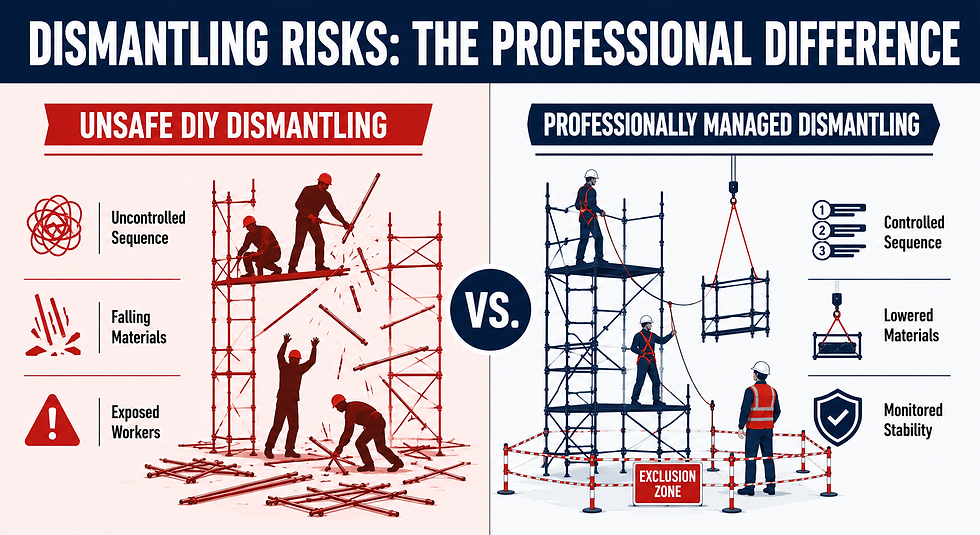
Risk | What Can Happen | How Professional Dismantling Helps |
Loss of stability | Removing components in the wrong sequence can destabilise the remaining structure | Trained scaffolders follow a controlled sequence and monitor stability as sections come down |
Falling materials | Components or tools can fall and injure people below | The work area is controlled while materials are safely lowered and removed |
Falls from height | Workers are exposed as platforms and guardrails are removed | Competent scaffolders use appropriate methods and safe practices throughout |
Unauthorized access | Others may enter the dismantling area | The area is restricted and coordinated with the wider site team |
Changing access routes | Removing sections can affect how people move around the building | Dismantling is planned around the work that's still ongoing |
Site disruption | Poor coordination can interrupt other trades or delay the project | Removal is scheduled and communicated with everyone involved |
The Risks of Cutting Corners
When scaffolding is erected or dismantled by unqualified teams, or rushed to save time, the consequences can include:
Structural failure or collapse, putting workers and the public at risk
Falls from height, one of the leading causes of serious injury on construction sites
Regulatory breaches, leading to fines, project shutdowns, or legal liability
Project delays, if unsafe scaffolding is flagged and work has to stop
Reputational damage, for builders and contractors associated with an unsafe site
For homeowners, the risks are just as real — an unstable scaffold on a private renovation is a liability no one wants attached to their property.
What to Check Before Hiring a Scaffolding Contractor
The cheapest quote isn't always the most suitable one. Before hiring, it's worth asking:
How will you assess the site, and is the proposed scaffold actually suitable for this work?
What's your process for training and supervising scaffolders?
Are you fully insured, and can you confirm your safety accreditation?
How long will the scaffold remain in place, and how are inspections handled during that time?
What happens if our requirements change mid-project?
Having this conversation before the erection date gives everyone a clearer picture of what the project actually needs.
When Should You Arrange Erection and Dismantling?
Ideally, scaffolding should be discussed before your project reaches the stage where access becomes essential. Early planning gives your contractor time to properly assess the site, understand your programme, and flag any unusual requirements — including weather-sensitive timing, which can affect both erection and dismantling.
Don't treat dismantling as an afterthought either. Agreeing a likely removal date and sequence early makes it much easier to coordinate roofing, rendering, painting, maintenance, and other external works around it.
Frequently Asked Questions
How long does professional scaffolding erection usually take? It depends on the size and complexity of the structure. A typical residential job can often be erected within a day, while larger commercial projects take longer to ensure everything is properly assessed, installed, and signed off.
Do I need scaffolding for a small home renovation?
If any work involves height — roofing, guttering, upper-storey painting, or extensions — scaffolding provides safer, more stable access than ladders alone, and is often the appropriate choice for compliance.
Is scaffolding insurance really necessary?
Yes. Fully insured scaffolding protects homeowners, builders, and contractors from liability if anything goes wrong, and is a strong sign the provider takes safety and professionalism seriously.
How often should scaffolding be inspected once it's up?
Where a fall of 2 metres or more is possible, scaffolding must be inspected before first use and at least every 7 days after, with results recorded on the HSA's GA3 form — plus additional checks after bad weather or any alteration.
Can scaffolding be erected for both short-term and long-term projects? Yes. Scaffolding can be tailored for short-term repairs and maintenance or long-term builds and developments, with the setup adjusted to suit the project's duration and programme.
Ready for Scaffolding You Can Rely On?
Whether you're a contractor managing a large development, a builder juggling multiple sites, or a homeowner planning a renovation, safe and professional scaffolding isn't optional — it's the foundation everything else depends on. Safe Reach Scaffolding provides scaffolding erection and dismantling services for residential, commercial, contract, and private projects, so access planning becomes part of your project from the start rather than a problem to solve mid-build.

Get in touch with Safe Reach Scaffolding Ltd. today for a fully insured, professionally erected scaffolding solution — built for safety, reliability, and peace of mind.


Comments