
Scaffolding Safety in Ireland: What Cork Contractors Need to Get Right
A scaffold can be the thing that keeps a project moving. It can also be the thing that stops it in its tracks.
A missed inspection. A scaffold that needs adjusting. High winds. Materials left where they should not be. Another trade removing a component without realising what it does.
Suddenly, the job that was meant to take a few days is creating delays, calls and headaches.
For contractors working across Cork, scaffolding safety in Ireland is about much more than preventing falls. It is about creating a safe, reliable working platform that allows the rest of the site to do its job.
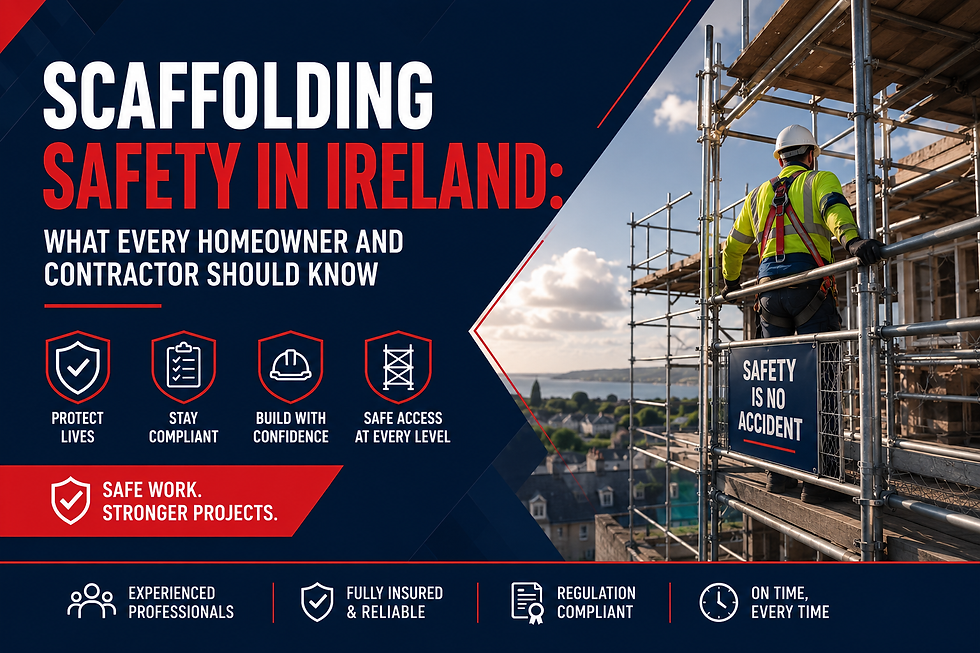
TL;DR
Scaffolding needs proper planning before it reaches the site.
Competent people must erect, alter, inspect and dismantle scaffolding.
Working scaffolds must be inspected before use and at required intervals.
High winds and other events can affect scaffold safety.
Other trades should never remove ties, boards or scaffold components themselves.
A reliable scaffolding partner can help prevent avoidable delays on site.
Why Scaffolding Problems Quickly Become Project Problems
Most contractors do not have time for unnecessary complications.
You have roofers waiting. Bricklayers working to a programme. Renderers coming in behind them. Materials arriving when they are supposed to. Clients expecting progress.
The scaffold sits in the middle of all of this.
When it is properly planned and managed, it becomes part of the site's infrastructure. When it is poorly managed, everyone notices.
The HSA's guidance places significant emphasis on planning, competent personnel, inspections and proper management of scaffolding. It also makes clear that contractors using scaffolding must be satisfied that it is safe before they use it.
That is why choosing a scaffolding company based purely on the cheapest quotation can be a false economy.
A saving at the start is not much of a saving if the scaffold causes problems halfway through the job.
Scaffolding Safety in Ireland Starts Before the Scaffold Arrives
One of the easiest mistakes is thinking about scaffolding only when the lorry turns up.
Good planning starts earlier.
Before erection begins, the scaffold needs to suit the building, the work being carried out and the conditions around the site. That includes considering access, ground conditions, loading requirements and how the scaffold will interact with the structure.
For contractors, there is another important question:
How will the scaffold work with the other trades on site?
A scaffold may be perfectly suitable for one stage of a project and need adjustment for another. If that is not considered early, delays can follow.
The HSA Code of Practice recommends that erection, use and dismantling are planned to minimise risks. It also places responsibility for scaffold management firmly within site management.
In other words, scaffolding should be part of the project plan, not an afterthought.
The Cork Weather Factor: What Happens When Conditions Change?
Anyone who works in Cork knows that the weather does not always respect the construction programme.
A scaffold can be perfectly secure when erected and then face very different conditions later.
Strong winds can affect scaffold components, sheeting and decking. The HSA has specifically highlighted the risk of decking boards being displaced by high winds and stresses the importance of appropriate inspection.
That means a contractor should know what happens when severe weather hits.
Ask:
Who checks the scaffold after significant weather?
Who should be contacted if something looks wrong?
Can adjustments be arranged quickly when site requirements change?
Are workers clear that they must not alter the scaffold themselves?
These questions are practical, not excessive.
The HSA specifically warns that unauthorised removal of ties or scaffold components can affect stability and potentially result in collapse.
Need dependable scaffolding for your next Cork project?
If your scaffold needs to support several trades, remain reliable throughout the job and meet the necessary safety requirements, working with the right scaffolding company matters.
Safe Reach Scaffolding Ltd. can discuss your project requirements and provide a quotation based on what the site actually needs.
Get in touch to discuss your scaffolding requirements.
Inspections Are Not Just Another Box to Tick
This is one area where assumptions can cause problems.
A scaffold should not simply be erected and forgotten about until the job is finished.
The HSA Code of Practice states that a contractor using a scaffold should ensure it has been inspected before use and within the previous seven days, with inspection results recorded. Inspections are also required following events that could affect the scaffold's safety.
For a busy site, that matters.
A scaffold can be affected by:
Severe weather
Alterations or adjustments
Impact from site equipment
Changes in how it is being used
Damage to individual components
There is also the condition of the scaffold itself.
The HSA has warned about corroded and damaged scaffolding components, noting that defective components can compromise structural integrity.
A quick visual check is not a substitute for the required inspection process.
Competence Matters More Than a Van and a Stack of Tubes
Scaffolding is specialist work.
The HSA identifies scaffolding as a task covered by the Construction Skills Certification Scheme, including basic and advanced scaffolding activities.
For contractors, this is worth checking before appointing a scaffolding company.
You want to know that the people working on your site understand what they are doing and that the company takes its responsibilities seriously.
That includes erection, alteration, maintenance, inspection and dismantling.
It also means knowing who is responsible when something needs to change.
A good working relationship makes this much easier. Instead of everyone asking, "Who is supposed to sort that?", there should be a clear answer.
Keep Other Trades From Creating Unnecessary Risk
Construction sites are busy places. People are focused on getting their own work finished.
That can create a problem when scaffolding gets in the way.
A roofer needs access. A plasterer needs space. Materials need to be moved. Someone decides a tie is inconvenient.
That last one is where things can become serious.
Workers should never remove or alter scaffold components themselves. The HSA explicitly warns against removing ties or interfering with scaffolding because doing so can affect its stability.
If a change is needed, it should be dealt with by the appropriate competent people.
It might take an extra conversation.
That is considerably better than an unsafe scaffold.
What Should Cork Contractors Ask Their Scaffolding Company?
Before work starts, get clear answers to a few straightforward questions:
What type of scaffold does the project require?
Who is responsible for inspections?
How are inspection records maintained?
What happens after severe weather?
How will scaffold adjustments be handled?
How will access be managed around the site?
Is the company appropriately insured?
Who should the site manager contact if there is a problem?
You do not need a twenty-page conversation.
You just need clear answers.
Final Thoughts
Scaffolding safety in Ireland is ultimately about more than tubes, boards and guardrails.
It is about giving people a dependable place to work.
For Cork contractors, that reliability has a practical value. It helps trades work safely, keeps projects organised and reduces the chance of avoidable disruption.
The HSA's approach to work at height is clear: work should be properly planned, risks assessed, suitable equipment selected, competent people used and equipment properly inspected and maintained.
The right scaffolding partner should make those responsibilities easier to manage, not add another problem to your list.
If you are planning a construction, roofing, renovation or maintenance project in Cork, speak to Safe Reach Scaffolding Ltd. about your requirements and request a quotation.
Thank you for reading.


Comments